







§ 136 Abs. 1 StPO
Silence
You only have to give your personal details. You may refuse to say anything at all about the allegation.
 Hagemann de GrzymalaCriminal Defence
Private clients
General criminal lawSummons, penalty order, indictmentHomicide casesTrials before the homicide chamberDrug offencesNarcotics Act and Cannabis ActCybercrimeOffences on the internet
After an arrest, a judge often decides as early as the next day whether to order pre-trial detention. Karolin Hagemann de Grzymala, LL.M., certified specialist lawyer for criminal law, represents people who have been arrested before the custody judge (Haftrichter), at detention reviews and throughout their detention. Relatives can contact her directly.
Until you see the custody judge: personal details yes, statement on the allegation no.
Pre-trial detention (Untersuchungshaft) means losing your liberty before any judgment has been given. A judge may only order it if there is strong suspicion (dringender Tatverdacht) and a ground for detention, usually a risk of flight or a risk of tampering with evidence (§ 112 StPO). Anyone who is provisionally arrested must be brought before a judge by the day after the arrest at the latest. From that point at the latest, they are entitled to a defence lawyer, and there are two ways to challenge the detention: the detention review (Haftprüfung) and the complaint against detention (Haftbeschwerde).
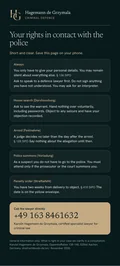 Your rights in contact with the policeOne page as a PDF to save on your phone
The police may provisionally arrest you (vorläufige Festnahme) if the conditions for an arrest warrant are met and there is no time to ask a judge (§ 127 Abs. 2 StPO). You must then be informed of your rights in writing and in a language you understand (§ 114b StPO). These are your rights:
You only have to give your personal details. You may refuse to say anything at all about the allegation.
You may consult a defence lawyer of your choice even before you are questioned.
You may inform a relative or a person you trust, as long as this does not seriously endanger the investigation.
You can ask to be examined by a doctor. If you do not speak enough German, you are given an interpreter free of charge.
Foreign nationals can ask for their consulate to be informed.
No statement without a defence lawyer
Many people who are arrested want to clear up what they see as a misunderstanding straight away. Do not do this. Every sentence you say at the police station or in the cell may later appear in the file. Insist on calling your defence lawyer: +49 163 8461632.
If the judge orders pre-trial detention, the judge must ensure that a relative or a person of trust is notified without delay (§ 114c Abs. 2 StPO). Until then, a great deal remains unclear. These steps help:
Have the person’s name, date of birth and the place of arrest ready. A defence lawyer can make enquiries with the police and speak to the person arrested before they are brought before the judge.
A certificate of registration (Meldebescheinigung), an employment contract or a tenancy agreement shows firm ties. This counts when the court considers the risk of flight.
Do not discuss the alleged offence on the phone or in messages.
Even well-meant conversations can be seen as an attempt to influence what witnesses say.
Good to know
Spouses, fiancés and fiancées and close relatives do not have to give evidence against the suspect (§ 52 StPO). Unmarried partners do not have this right. The person arrested decides who defends them. We only pass on to the family what they tell us with their consent.
Usually only hours pass between the arrest and the decision on detention, at most until the end of the following day. This is how it works:
The police take you to the station and inform you of your rights in writing (§§ 127 Abs. 4, 114b StPO).
The police secure evidence and often try to question you. The public prosecutor’s office decides whether to apply for an arrest warrant (Haftbefehl).
If a judge is to decide on detention, a defence lawyer is appointed for you (Pflichtverteidigung). You may name the lawyer yourself (§§ 140 Abs. 1 Nr. 4, 142 Abs. 5 StPO).
By the day after the arrest at the latest, the judge at the Local Court (Amtsgericht) questions you. The judge gives you the opportunity to dispel the suspicion and the grounds for detention (§§ 128, 115 Abs. 3 StPO).
The judge releases you, suspends an arrest warrant subject to conditions or orders pre-trial detention (§§ 128 Abs. 2, 116 StPO).
You are taken to a prison (Justizvollzugsanstalt, JVA) and receive a copy of the arrest warrant (§ 114a StPO).
Good to know
If there is already an arrest warrant, you are brought before the court that issued it. If that is not possible in time, the nearest Local Court deals with you first (§§ 115, 115a StPO). In this case, too, you must have a defence lawyer. How to choose your defence lawyer yourself is explained on the page Court-appointed counsel.
If another country requests extradition, the Act on International Cooperation in Criminal Matters (IRG) applies. You are brought before the nearest Local Court by the day after the arrest at the latest (§ 22 IRG). The Higher Regional Court (Oberlandesgericht) then decides on detention pending extradition and on extradition itself. You must have a lawyer (§ 40 Abs. 2 IRG). Do not agree to a simplified extradition before you have taken advice. Your consent cannot be withdrawn (§ 41 Abs. 3 IRG). More on this under Extradition. If you live outside Germany, our guide Arrested in Germany summarises the key points.
Pre-trial detention is not a punishment. It requires strong suspicion and a ground for detention, and it must not be out of proportion to the significance of the case and the expected sentence (§ 112 Abs. 1 StPO).
Good to know
The suspect has fled or is in hiding.
There is a risk that the suspect will evade the proceedings (Fluchtgefahr).
The suspect’s conduct gives rise to a strong suspicion that they will destroy evidence or influence witnesses (Verdunkelungsgefahr).
For murder, manslaughter and certain other serious crimes, detention is possible even without these grounds.
This ground can apply to certain sexual offences and to repeated serious offences, such as robbery or drug dealing (Wiederholungsgefahr).
Bail paid by a relative
The judge sets the amount of the security at their discretion (§ 116a Abs. 2 StPO). If the suspect evades the proceedings, the bail is forfeited to the state (§ 124 StPO). This also applies if relatives provided the money.
A high expected sentence alone does not usually establish a risk of flight. The court must also take into account what speaks against flight: family, work, a home, or the fact that the person has faced the proceedings so far. Even in cases of murder and manslaughter, the Federal Constitutional Court requires circumstances suggesting that, without detention, the investigation or punishment of the offence could be put at risk.
If less drastic measures are sufficient, the execution of the arrest warrant is suspended (Haftverschonung). Where there is a risk of flight, the judge must do this. Where there is a risk of tampering with evidence or of reoffending, the judge may do so (§ 116 StPO). The arrest warrant remains in force, but you live at home again. Typical conditions are:
Anyone who seriously breaches the conditions or makes preparations to flee must expect the arrest warrant to be enforced again (§ 116 Abs. 4 StPO).
You report regularly to the police or another authority.
You only leave your place of residence with permission.
You or another person deposit bail (Kaution) or provide a guarantee.
You have no contact with co-suspects or witnesses.

Call directly
+49 163 8461632You reach the lawyer in person. Everything you say is covered by professional confidentiality from the first call.
Both remedies aim to have the arrest warrant cancelled or suspended subject to conditions. They cannot be used at the same time: while an application for a detention review is pending, a complaint is not admissible (§ 117 Abs. 2 StPO).
Good to know
As long as you are in pre-trial detention, you can apply for a detention review.
The court that issued the arrest warrant decides. Before charges are brought, this is usually the investigating judge.
On application, an oral hearing is held. Unless you agree to a later date, it must take place within two weeks of the application being received.
Good to know
If there are new circumstances, such as a place to live, a job or an offer of bail, there is much to be said for a detention review. If another court is to reassess the suspicion or the ground for detention, a complaint is usually more suitable. Before deciding, we look at the parts of the file on which the arrest warrant is based (§ 147 Abs. 2 Satz 2 StPO).
If the Local Court does not grant the complaint itself, the Regional Court (Landgericht) decides.
The court hearing the complaint usually decides on the basis of the file. An oral hearing is possible.
If the Regional Court upholds the detention, the case can be taken to the Higher Regional Court.
There is no fixed upper limit. But detention must remain proportionate, and detention cases must be dealt with particularly quickly.
Detention without a judgment may only last longer if particular difficulties, the particular scope of the investigation or another important reason do not yet allow a judgment.
This is decided by the Higher Regional Court, which in Aachen is the Higher Regional Court Cologne. It reviews whether detention should continue at least every three months.
If detention is based on this ground, it may last no longer than one year in total.
Good to know
Pre-trial detention is generally credited against any later sentence (§ 51 StGB). Anyone who is acquitted can claim compensation, for non-material damage 75 euros for each day or part of a day (§§ 2, 7 StrEG).
Which prison is responsible is set out in the enforcement plan of the state of North Rhine-Westphalia. In the Aachen area, pre-trial detention is carried out at Cologne Prison (JVA Köln) in Ossendorf and at Aachen Prison, among others. How often and for how long visits are possible is governed by the North Rhine-Westphalia Pre-Trial Detention Act (Untersuchungshaftvollzugsgesetz NRW) and the prison’s house rules.
Conversations and letters with the defence lawyer are not monitored.
The court can order that visits, phone calls and letters require permission and are monitored.
You can apply for a court decision against such restrictions.
Not a word about the allegation
What is said in the visiting room, on the phone or in a letter may be listened to or read. Fellow prisoners can later give evidence as witnesses. Only talk about the allegation with your defence lawyer.
Relatives arrange visiting appointments with the prison. If a visiting permit is required, it is issued by the court or the public prosecutor’s office.
Karolin Hagemann de Grzymala, LL.M., certified specialist lawyer for criminal law in Aachen
In detention cases, every day counts. Karolin Hagemann de Grzymala, LL.M., is a certified specialist lawyer for criminal law and a former member of the board of the Strafverteidigervereinigung NRW e.V., the association of criminal defence lawyers in North Rhine-Westphalia. She takes on the defence personally, whether privately instructed or appointed by the court. This is how we proceed:
The firm is based in Aachen and defends clients in Aachen. We also speak to relatives by video conference. The language of the conversation is agreed at first contact, and a sworn interpreter can take part if needed. If the allegation concerns a killing, read more under Homicide. After a search, see the page on house searches. You can arrange a conversation by phone or via the contact page.

After an arrest, a judge at the Local Court decides on detention. After six months, the Higher Regional Court decides whether detention continues.
Aachen
In the Aachen area, the Local Court Aachen usually decides, and pre-trial detention is carried out at Aachen Prison, among others. The Higher Regional Court Cologne is responsible for both cities.
Criminal lawyer in AachenFurther questions that often become important in this situation.
Answers to the questions people who have been arrested, and their families, ask in the first few days.
If they are placed in pre-trial detention, the court must order that a relative or a person they trust is notified (§ 114c Abs. 2 StPO). Before that, they may inform someone themselves, as long as this does not seriously endanger the investigation. Call us. As defence lawyers, we can find out where they are and when they will be brought before the judge.
Until the end of the day after the arrest at the most. By then, the police must either release you or bring you before a judge (§ 128 StPO, Art. 104 GG). If the only purpose is to establish your identity, no more than twelve hours are allowed (§ 163c StPO).
It depends on the case. In a detention review, the court that issued the arrest warrant decides, on application after an oral hearing (§§ 117, 118 StPO). With a complaint, a higher court reviews the detention, usually on the basis of the file (§ 304 StPO). You cannot do both at the same time.
Sometimes. If detention is based solely on a risk of flight, the judge must suspend the arrest warrant if less drastic measures such as bail are sufficient (§ 116 Abs. 1 StPO). The judge sets the amount. Further conditions are usually added, such as a duty to report to the police.
As a rule, yes, against a prison sentence as well as against a fine (§ 51 StGB). Anyone who is acquitted can claim compensation for non-material damage of 75 euros for each day or part of a day (§ 7 Abs. 3 StrEG).
Yes, as soon as they are to be brought before a judge for a decision on detention and do not yet have a defence lawyer (§§ 140 Abs. 1 Nr. 4, 141 Abs. 2 StPO). Before that, they may name a defence lawyer they trust. If they do not name anyone, the court chooses.
A first conversation clarifies where you stand and what needs to happen next.
+49 163 8461632