







§ 105 Abs. 1 StPO
Judge’s order
As a rule, only a judge may order a search.
 Hagemann de GrzymalaCriminal Defence
Private clients
General criminal lawSummons, penalty order, indictmentHomicide casesTrials before the homicide chamberDrug offencesNarcotics Act and Cannabis ActCybercrimeOffences on the internet
The doorbell rings early in the morning, and officers with a search warrant are standing at the door. What you say, hand over and sign in the next few hours can shape the whole case. Karolin Hagemann de Grzymala, LL.M., certified specialist lawyer for criminal law, explains what you have to put up with and what you do not.
Your objection will not stop the search. But it counts later.
During a house search you have to tolerate the search, but you do not have to cooperate with it. Ask to see the search warrant (Durchsuchungsbeschluss), say nothing about the allegation and do not hand anything over of your own accord. Object expressly to every seizure and have your objection entered in the record. Call your defence lawyer while the search is still going on.
Checklist: the police are in your home
Stay calm and do not obstruct the officers. Ask for the search warrant and a copy of it. Do not comment on the allegation, not even in passing. Hand nothing over voluntarily and do not give any PIN or password. Object to the search and to every seizure, and have this recorded. Do not sign anything. Call: +49 163 8461632.
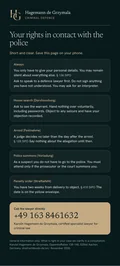 Your rights in contact with the policeOne page as a PDF to save on your phone
Searches are governed by §§ 102 ff. of the Code of Criminal Procedure (Strafprozessordnung, StPO). A search interferes with the fundamental right to the inviolability of the home (Art. 13 GG, the German constitution), so fixed rules apply. The most important one: you have to accept the search, but you do not have to help with it. An initial suspicion (Anfangsverdacht) is enough for a search. It does not require any evidence against you.
As a rule, only a judge may order a search.
Only if waiting for a judge would put the purpose of the search at risk (Gefahr im Verzug) may the public prosecutor’s office and the police order it themselves.
You do not have to say anything about the allegation. You only have to give your personal details.
As the occupant, you may be present. If you are not there, an adult relative, flatmate or neighbour should be called in where possible.
If neither a judge nor a prosecutor is present, a municipal official or two members of the local community should be called in as witnesses where possible. Police officers may not take on this role.
At night, a home may only be searched in exceptional cases, for example when someone is pursued immediately after being caught in the act, or in urgent cases.
You may call in a defence lawyer at any stage of the proceedings.
Good to know
An urgent order is not a mere formality. According to the case law of the Federal Constitutional Court (Bundesverfassungsgericht), investigators must normally try to reach a judge first and must document their reasons for ordering the search themselves. If they do not, the search may be unlawful.
If necessary, the officers may have locked doors and cupboards forced open. Unlocking them yourself prevents damage. It does not count as a statement about the allegation.
Most searches follow the same pattern:
The officers state the reason and show the warrant, or say that the matter is urgent. Ask who is in charge of the operation and write down the name.
The rooms named in the warrant are searched. This often includes the cellar, garage or car. Stay close by and watch what is taken.
The officers take into custody anything that might serve as evidence. Do not hand anything over voluntarily, and object expressly.
Ask for a list of all items taken (§ 107 StPO). Check that your objection has been noted. You do not have to sign anything.
On request, you receive written notice of the reason for the search. Sometimes a summons follows, or an arrest if there is an arrest warrant.
Good to know
If an arrest warrant is executed during the search, or you are provisionally arrested, additional rules apply. More on this under Arrest and pre-trial detention.
Searches are particularly common when the allegation concerns drugs. They are often triggered by a statement from a third party, an intercepted parcel or a chat history from another case. If the police find drugs, scales or cash, the rule applies all the more: explain nothing and say nothing about who anything belongs to. In homes with several occupants, it is often unclear who owns what. Searches also take place under the Cannabis Act, for example on suspicion of dealing. More on this under Drug offences.
The search warrant is an order made by the investigating judge (Ermittlungsrichter) at the Local Court (Amtsgericht). It authorises the search and limits it at the same time. The officers may only look for what the warrant names, and only where it allows them to look. Check these points:
Which Local Court issued the warrant, and when?
Who are the proceedings against, and are you a suspect or an uninvolved third party?
Which offence is alleged, and when and how is it supposed to have been committed?
Which home, which other rooms and which vehicles may be searched?
What are they looking for? The description must be specific enough for the search to be measured against it.
What is the suspicion based on, and why is the search proportionate?
Good to know
A warrant that only repeats the wording of the law or describes the allegation in very general terms can be challenged. According to the case law of the Federal Constitutional Court, a warrant also loses its effect after six months at the latest. Errors in the warrant do not stop the search on the spot, though. Do not argue with the officers. Read the warrant out to your defence lawyer over the phone instead.
If the warrant cites § 103 StPO, you are not a suspect yourself. The officers are then searching your home for traces or evidence against another person, and stricter conditions apply. If you are closely related to that person or married to them, you may refuse to give evidence (§ 52 StPO).

Call directly
+49 163 8461632You reach the lawyer in person. Everything you say is covered by professional confidentiality from the first call.
The officers take into custody items that may serve as evidence (Sicherstellung, § 94 Abs. 1 StPO). One detail matters here. If you hand an item over voluntarily, no formal seizure is needed. This also means there is no court review, which a seizure is subject to. If you refuse to hand the item over, it must be formally seized (Beschlagnahme, § 94 Abs. 2 StPO).
Say clearly: “I object to the search and to the seizure.” You do not have to give reasons.
If the officers seized items without a judge’s order and you objected, they should apply to the court for confirmation within three days.
You yourself can apply at any time for a court to review the seizure.
On request, you receive a list of the items taken. If nothing suspicious is found, you receive a certificate confirming this.
If the officers come across indications of another offence, they may provisionally seize those items as well.
Do not sign anything
At the end, the officers often present a form. It sometimes states that you handed items over voluntarily or did without search witnesses. You are not obliged to sign it. Ask instead to be given the list of items taken.
Your objection will not halt the search. But it ensures that nobody can later claim you agreed. Documents relating to your defence, such as letters from your defence lawyer, are specially protected. Point this out and insist that it is recorded.
If the officers offer to cut the search short if you pick out certain documents yourself, discuss this with your defence lawyer first.
Today almost every search is also about data. Smartphones, laptops and hard drives are often taken away. For many people, losing their phone is harder to bear than the search itself.
You do not have to give your PIN or password. Nobody is obliged to help prove their own guilt.
Since March 2025, the Federal Court of Justice (Bundesgerichtshof) has held that investigators may, under certain conditions, place a suspect’s finger on the sensor by force to unlock the device.
Papers and storage media that are taken away are at first only reviewed (Durchsicht). Only then is it decided what is seized as evidence.
The review may be extended to data in the cloud if it can be accessed from the device and would otherwise be at risk of being lost.
You can also go to court against items being taken away for review and against data being provisionally secured.
Good to know
Analysing large amounts of data can take months. The defence can press for only copies of the relevant data to be made, so that you get the device back. Proportionality sets limits where private photos, health data or professional secrets are concerned. If the allegations relate to the internet, read more under Cybercrime.
Once the officers have left, the real work of the defence begins. On the same day, write down who was there, what was said and what was taken.
Your defence lawyer requests access to the investigation file (Akteneinsicht). The file shows what the suspicion is based on.
You can lodge a complaint (Beschwerde) against the search warrant, even if the search is already over. The court then examines whether the search was lawful.
You can ask the court to rule on a seizure made without a judge’s order and on the way the search was carried out.
Items that are no longer needed for the proceedings must be returned.
Good to know
Until the file is available, say nothing about the allegation, not even to neighbours, colleagues or others involved. Do not delete any data, not even remotely through an online account. Anyone who coordinates their story with others or removes traces risks being accused of tampering with evidence, which is a ground for detention (§ 112 Abs. 2 Nr. 3 StPO). A search is often followed later by a summons. What you should do then is explained under Police summons as a suspect.
In cases of fraud, breach of trust, tax evasion or withholding social security contributions, investigators also turn up at offices, medical practices and warehouses. The rules are the same, but the situation is harder to keep track of: many rooms, many employees, large amounts of data.
One person from management accompanies the officers and is available to them.
Employees are usually witnesses, not suspects. As a rule, they are not obliged to answer spontaneous questions on the spot.
It can often be agreed that the IT team copies specific data, instead of whole servers being taken away.
Good to know
With a fixed plan of action, a company remains able to act in this situation. How such a plan is drawn up is explained under Compliance. Defence against allegations arising from business life is described on the page White-collar crime.
Karolin Hagemann de Grzymala, LL.M., certified specialist lawyer for criminal law in Aachen
As a certified specialist lawyer for criminal law, Karolin Hagemann de Grzymala, LL.M., defends clients in Aachen. She runs her own firm in Aachen and was previously a partner at DMFH Fachanwälte für Strafrecht. She supports you from the search through to the end of the proceedings.
If you reach her during the search, she speaks directly to the officer in charge. She has the warrant read out to her, tells you what you have to accept and makes sure that your objection is recorded. Afterwards she applies for access to the file, examines the warrant and the seizure and deals with the return of your devices. Only once the contents of the file are known do you decide together with her whether to remain silent or to make a statement through your defence lawyer.
Your next step
Call: +49 163 8461632. If the search is already over, you are also welcome to use the form on the contact page. A first confidential conversation is also possible by video conference. The language of the consultation is agreed at first contact, and a sworn interpreter can take part if needed.

The search warrant is usually issued by the investigating judge at the Local Court in the district where the public prosecutor’s office is based (§ 162 StPO). This is how it works in the Aachen area.
Aachen
In the Aachen area, the Local Court Aachen decides at the request of the Public Prosecutor’s Office Aachen. In the border region, a search can also stem from a request for mutual legal assistance from Belgium or the Netherlands.
Criminal lawyer in AachenFurther questions that often become important in this situation.
Answers to questions clients often ask after a search.
At night, a home may only be searched in exceptional cases. From April to September, night-time runs from 9 pm to 4 am, and from October to March from 9 pm to 6 am (§ 104 StPO).
Investigators therefore often start shortly after night-time ends. That is when they usually find the occupants at home.
Only in urgent cases, meaning that evidence would be lost by the time a judge had decided (§ 105 StPO). The officers must document their reasons for this. A court can review afterwards whether the urgent order was justified. Object to the search and have your objection recorded.
Yes. You may take advice from a defence lawyer at any stage of the proceedings (§ 137 StPO). However, the officers do not have to wait for your lawyer to arrive before searching. A phone call in which your defence lawyer speaks to the officer in charge often helps.
You may keep access codes such as your PIN or password to yourself. Fingerprints are different: under a 2025 decision of the Federal Court of Justice, investigators may unlock a smartphone this way under certain conditions, even against the suspect’s will. Do not resist. Object and have your objection recorded.
No. An initial suspicion is enough for a search. Many investigations are later dropped. What happens next depends on what was found and what is in the file. That is why you should only comment after your lawyer has seen the file, if at all.
A first conversation clarifies where you stand and what needs to happen next.
+49 163 8461632