









We visit your relative
In that conversation, we find out whether they want to instruct us.
 Hagemann de GrzymalaCriminal Defence
Private clients
General criminal lawSummons, penalty order, indictmentHomicide casesTrials before the homicide chamberDrug offencesNarcotics Act and Cannabis ActCybercrimeOffences on the internet
A phone call, an arrest, and suddenly a member of your family is in custody. This page explains step by step what happens now, what you can do and what is better left undone. Karolin Hagemann de Grzymala, LL.M., certified specialist lawyer for criminal law, advises relatives from the very first call.
What your relative tells us is protected by professional confidentiality.
If a relative has been arrested, they must be brought before a judge, who decides on pre-trial detention (Untersuchungshaft), by the day after the arrest at the latest (§ 128 StPO). Until then, the most important thing you can do is call a criminal defence lawyer, who contacts your relative and offers to defend them at this hearing. Do not talk to the police about the allegation yourself. Spouses, fiancés and fiancées and close relatives may refuse to give evidence (§ 52 StPO).
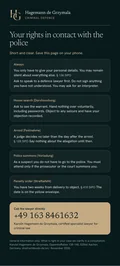 Your rights in contact with the policeOne page as a PDF to save on your phone
Families often hear nothing at first. An expected call does not come, the phone is switched off, or the police are at the door. After a provisional arrest, the person is usually in police custody, which means a cell at a police station. If there was already an arrest warrant (Haftbefehl), they are brought before the competent court without delay (§ 115 StPO). The person arrested may notify a relative or a person they trust without delay, as long as this does not seriously endanger the investigation (§ 114c Abs. 1 StPO). If the judge orders pre-trial detention, the court itself must ensure that someone from the family or a person of trust is informed (§ 114c Abs. 2 StPO). As a rule, this only tells you that your relative is in custody and where. A defence lawyer can ask the police and the public prosecutor’s office where your relative is and when the hearing before the judge is planned.
The police take your relative away, sometimes after searching the home. Your relative is informed of their rights and may remain silent.
Your relative may inform you or another person they trust (§ 114c StPO). This is the moment to call a defence lawyer.
By the day after the arrest at the latest, a judge (Haftrichter) examines whether there is strong suspicion and a ground for detention such as a risk of flight (§§ 112, 128 StPO). If your relative does not yet have a defence lawyer, one must be appointed by this point at the latest (§ 141 Abs. 2 StPO).
The judge releases your relative, issues an arrest warrant or suspends the arrest warrant subject to conditions (§ 116 StPO).
Your relative is taken into pre-trial detention. From now on, rules on visits, post and phone calls apply, set by the court and the prison (Justizvollzugsanstalt, JVA).
Your relative can apply for a detention review (Haftprüfung) at any time (§ 117 StPO). The defence prepares this with you, for example with proof of a home and a job.
Good to know
The legal details are explained on the page Arrest and pre-trial detention. If your family lives outside Germany, our guide Arrested in Germany may also help.
Many families first ask whether they are allowed to instruct a lawyer for their relative at all. You may take the first step: call, describe the situation and get things moving. But the authority to act for the defence (Vollmacht) must be given by the suspect personally.
In that conversation, we find out whether they want to instruct us.
With it, we act on their behalf and apply for access to the investigation file.
Even if you pay the fees, only your relative decides how they are defended.
Good to know
Anyone who is brought before the custody judge or is in pre-trial detention must have a defence lawyer (§ 140 Abs. 1 Nr. 4 and 5 StPO). Before the court appoints counsel (Pflichtverteidigung), the suspect may name someone. The lawyer named is appointed unless there is an important reason against it (§ 142 Abs. 5 StPO). So call early, so that your relative knows whom they can name. More on this under Court-appointed counsel. The state pays the costs at first. Anyone who is convicted usually has to pay them back (§ 465 StPO). Details are on the page Costs of the defence.
If your son or daughter is under 18, you as their legal representatives can choose a defence lawyer independently (§ 137 Abs. 2 StPO). If a young person is deprived of their liberty, the parents or guardians must in principle be informed without delay (§ 67a Abs. 2 JGG).

Call directly
+49 163 8461632You reach the lawyer in person. Everything you say is covered by professional confidentiality from the first call.
Not a word about the allegation
Do not talk about the allegation on the phone, in letters, in messaging apps or during visits. Visits, phone calls and post in pre-trial detention can be monitored. What you say or write can end up in the investigation file.
Even a friendly chat at the front door is questioning. Say that you will take advice first.
Do not talk to witnesses or co-suspects about what is supposed to have happened. Even the appearance of this can count as a risk of tampering with evidence (Verdunkelungsgefahr) and prolong detention.
Leave documents and devices that could be connected with the allegation where they are.
Do not take any evidence to the police. Give it to the defence lawyer.
No posts on social media and no information to the press or neighbours.
Good to know
If your shared home has been searched, read the guidance on house searches.
Relatives are often summoned as witnesses. People close to the suspect may refuse to give any evidence at all, whether to the police, the public prosecutor’s office or the court (§ 52 Abs. 1 StPO). This right applies to:
Important for unmarried couples: if you only live together and are not engaged, you do not have this right. You must be informed of your rights before every questioning. You can still rely on the right even after you have started to give evidence (§ 52 Abs. 3 StPO). Take advice beforehand, if you wish from your own lawyer for witnesses (Zeugenbeistand). What applies if you receive a summons is explained under Police summons.
The court can order restrictions if they are necessary to prevent flight, tampering with evidence or new offences. Visits and phone calls then require permission, and visits, phone calls, letters and parcels are monitored (§ 119 Abs. 1 StPO). In addition, every prison has house rules with its own visiting hours.
Good to know
If permission has been ordered, you will only be admitted with a written visiting permit from the court or the public prosecutor’s office (§ 17 Abs. 5 UVollzG NRW). In everyday language it is often called a Sprechschein. The detention court is responsible, which during the investigation is usually the Local Court (Amtsgericht) that issued the arrest warrant. If it has passed the implementation to the public prosecutor’s office, you apply there instead (§ 119 Abs. 2 StPO). This is often the case during the investigation. Once you have the permit, you arrange an appointment with the prison and bring valid identification.
In North Rhine-Westphalia, people in pre-trial detention may receive visits for at least two hours a month. For visits from their children under 18, a further two hours should be allowed (§ 17 Abs. 1 and 2 UVollzG NRW). The prison sets out the details.
A prison officer may listen in. Talk about family, health and everyday life.
Only hand over what the prison has allowed.
If someone breaches a court order, the visit may be stopped.
Good to know
Letters are often the easiest way to stay in touch. If they are monitored, they take longer to arrive. Your relative may only make phone calls if the prison allows it and no court order prevents it (§ 19 UVollzG NRW). As a rule, you cannot phone your relative in prison. Conversations and post with their defence lawyer, on the other hand, are generally not monitored (§ 148 StPO).
In North Rhine-Westphalia, people in pre-trial detention may wear their own clothes if they arrange cleaning and changes of clothing themselves and there are no security or order concerns (§ 11 Abs. 1 UVollzG NRW). The prison decides how clothing is handed in.
Whatever you pay in or transfer is credited to your relative as personal funds (Eigengeld). They can use this money.
With it, they can buy food and personal items from the prison’s range in reasonable quantities.
Ask the prison for the account details and the payment reference, so that the money is allocated correctly.
Receiving parcels requires permission. Food, drink and tobacco are not allowed.
While your relative is in custody, life outside carries on.
Report the absence promptly. You do not have to say anything about the allegation. Agree what you say with the defence lawyer.
Explain in simple words that Mum or Dad cannot come home at the moment. If childcare is suddenly missing, the youth welfare office (Jugendamt) can help.
Rent, electricity, insurance and loans still have to be paid. Do not cancel anything in a hurry, and talk to the landlord or the bank before arrears build up.
For bank accounts, post and dealings with public authorities, you usually need a written power of attorney. Your relative can sign it in custody. Banks often require their own forms.
If your relative receives benefits, detention can change what they are entitled to. Inform the relevant office.
Pre-trial detention is not a judgment. The arrest warrant can be suspended if less drastic measures are sufficient (§ 116 StPO). The warrant then remains in force, but your relative is released subject to conditions (Haftverschonung). Nobody can say in advance whether the court will decide this way. Where there is a risk of flight, possible conditions include:
Your relative reports regularly to the police or another authority.
Your relative may not leave their place of residence without permission.
Your relative or someone else deposits money or valuables. In everyday language this is called bail (Kaution).
Before you provide bail
If your relative evades the proceedings, the security is forfeited to the state (§ 124 StPO). The money is then lost, even if it belongs to you. Talk openly with the defence lawyer beforehand.
The court examines whether a person has ties that keep them in the area. This is where the family can contribute a great deal:
If your relative is arrested on a European Arrest Warrant or a request for extradition from abroad, the Act on International Cooperation in Criminal Matters (IRG) applies. The Higher Regional Court (Oberlandesgericht) then decides on detention pending extradition (§§ 13, 15 IRG). More on this under Extradition.
A certificate of registration (Meldebescheinigung), a tenancy agreement or your assurance that your relative can live with you.
Confirmation from the employer that the job will be kept open.
The security can also be provided by someone else, so also by you. Money, securities, a pledge or a guarantee are all possible.
Karolin Hagemann de Grzymala, LL.M., certified specialist lawyer for criminal law in Aachen
Karolin Hagemann de Grzymala, LL.M., is a certified specialist lawyer for criminal law with her office in Aachen and defends clients in Aachen. We explain the next steps and say openly what we know and what we do not know yet.
What your relative tells us is covered by professional confidentiality, including towards the family. We only tell you what they allow us to pass on. This protects them, and it also protects you in case you are questioned as a witness later. The first conversation is also possible by video conference. The language of the consultation is agreed at first contact, and a sworn interpreter can take part if needed. You can reach us on +49 163 8461632 or via the contact page.

The first thing we establish is where the person arrested is being held and who decides on detention.
Aachen
In the Aachen area, the Local Court Aachen usually decides, and pre-trial detention is carried out at Aachen Prison, among others. When someone is arrested at the border, we also help families from Belgium and the Netherlands.
Criminal lawyer in AachenFurther questions that often become important in this situation.
Answers to the questions families often ask first after an arrest.
Do not talk to anyone about the allegation, not even to the police. Call a criminal defence lawyer. The lawyer finds out where your son is being held and offers to defend him when he is brought before the custody judge. This hearing must take place by the day after the arrest at the latest (§ 128 StPO). If your son is still a minor, you as his parents can choose a defence lawyer yourselves (§ 137 Abs. 2 StPO).
You can make contact, explain the situation and pay the fees. But your relative must give the authority to act personally. That is why we visit your relative first and find out whether they want to instruct us or name us as their court-appointed counsel (§ 142 Abs. 5 StPO).
If the court has ordered that visits require permission, you need a written visiting permit from the court or the public prosecutor’s office (§ 119 StPO, § 17 Abs. 5 UVollzG NRW). With the permit, you arrange an appointment with the prison. In North Rhine-Westphalia, people in pre-trial detention may receive visits for at least two hours a month.
No. Spouses, fiancés and fiancées, registered civil partners and close relatives such as parents, children and siblings may refuse to give evidence (§ 52 StPO). This applies at the police, at the public prosecutor’s office and in court. Unmarried partners only have this right if they are engaged.
Only if the prison allows phone calls and the court has not ordered otherwise (§ 119 StPO, § 19 UVollzG NRW). The calls can be monitored. So never talk about the allegation on the phone.
That is possible. The court can suspend the arrest warrant in return for a security. The security may also be provided by someone else, for example by depositing money or giving a guarantee (§§ 116, 116a StPO). If the suspect evades the proceedings, the security is forfeited to the state (§ 124 StPO).
A first conversation clarifies where you stand and what needs to happen next.
+49 163 8461632