







Police, as a suspect
There is no obligation to attend. If you stay away, there are no legal consequences.
 Hagemann de GrzymalaCriminal Defence
Private clients
General criminal lawSummons, penalty order, indictmentHomicide casesTrials before the homicide chamberDrug offencesNarcotics Act and Cannabis ActCybercrimeOffences on the internet
A letter from the police with an appointment for questioning and the word Beschuldigter, meaning suspect. Many people want to clear up the mistake quickly and simply go. Karolin Hagemann de Grzymala, LL.M., certified specialist lawyer for criminal law, explains why you are not obliged to attend and what makes more sense instead.
You can break your silence at any time. You can never take back a statement.
As a suspect, you do not have to comply with a police summons (Vorladung), and you do not have to say anything about the allegation there. You are only obliged to attend if the public prosecutor’s office or a court summons you (§ 163a Abs. 3 and § 133 StPO). Even then, you may remain silent. Have your defence lawyer cancel the appointment, and decide whether to make a statement only after she has seen the file (Akteneinsicht).
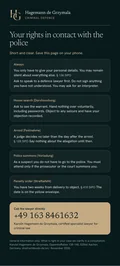 Your rights in contact with the policeOne page as a PDF to save on your phone
The answer depends on who is summoning you and in what role. Both are stated in the letter, usually in the subject line: as a suspect or as a witness.
There is no obligation to attend. If you stay away, there are no legal consequences.
You must attend, but you do not have to make a statement. If you stay away without a valid excuse, an order can be made for you to be brought there.
Here too you are obliged to attend, and here too you may remain silent.
You only have to attend and give evidence if the summons is based on an instruction from the public prosecutor’s office. This should be clear from the summons.
Here you must attend and give evidence, unless you have a right to refuse.
Be careful with phone calls and casual conversations
Sometimes the police phone or ring the doorbell “just to clear something up quickly”. What you say can end up in a note on the file and be used against you later. Say politely that you will not comment and that you are taking legal advice. Write down the officer’s name, the police station and the file number.
If you do not attend a police summons as a suspect, you are not admitting anything. The police then send the file to the public prosecutor’s office, which decides how to proceed. It may also summon you itself. It is better to have your defence lawyer cancel the appointment. The authority then knows that you are represented and directs any further questions to the firm.
Before your first questioning, the police must tell you which offence you are accused of (§ 163a Abs. 4 StPO). They must also inform you of your rights. This caution is based on § 136 StPO and applies at the police station just as it does in court.
You are free to decide whether or not to comment on the allegation.
You may consult a defence lawyer of your choice at any time, even before questioning.
Your defence lawyer may be present when the police question you.
You can request that evidence in your favour be gathered.
Threats, deception and promises of advantages that the law does not provide for are prohibited.
Good to know
If you remain completely silent, this may not be held against you. Silence is not an indication of guilt. It can be different if you answer on some points and not on others. The court may then, in some circumstances, draw conclusions from the gaps. That is why partial statements often do more harm than good.
If you were not properly cautioned, your statement generally cannot be used. However, the defence must object to its use at the trial in good time.
You become a suspect as soon as there is an initial suspicion. Sufficient factual indications are enough for this, and a criminal complaint (Anzeige) is often enough (§ 152 Abs. 2 StPO). It says nothing about guilt. People who are innocent are often the ones who want to clear up the misunderstanding straight away. That is understandable, but risky. You do not know what is in the file, who has said what and what evidence there is. A well-meant explanation can unintentionally confirm the very detail that gives the complaint its weight. A statement cannot be taken back. Your silence, on the other hand, you can end at any time.
Whether a statement will help you can only be judged once it is known what evidence there is against you. That is in the investigation file, which your defence lawyer inspects (§ 147 StPO). While the investigation is still ongoing, the public prosecutor’s office can restrict access if granting it would put the purpose of the investigation at risk (§ 147 Abs. 2 StPO). Once the investigation has been concluded, this restriction is no longer possible. This is what happens when you instruct us after receiving a summons:
You tell us what the letter says and what you know about the allegation. Everything you say is covered by the lawyer’s duty of confidentiality.
We notify the police that we are defending you and cancel the questioning appointment. You no longer need to contact them.
We apply to the public prosecutor’s office for access to the investigation file. It often takes a few weeks for the file to arrive.
We go through the file with you and establish what evidence there is and where it has gaps.
We then decide together whether you continue to remain silent or whether the defence submits a written statement. The aim is often to have the proceedings dropped (Einstellung des Verfahrens).
Good to know
A written statement submitted by the defence has advantages over being questioned. It can be worded calmly, and there is no record that gives a shortened version of your words. It is only submitted if it makes sense in light of the file. We discuss with you what may happen next, for example a penalty order (Strafbefehl).
Instead of a summons, the police often send a questionnaire (Anhörungsbogen). The law allows this in simple cases. The suspect is then given the opportunity to respond in writing (§ 163a Abs. 1 StPO). The same applies to the questionnaire as to questioning: it is an offer, not an obligation.
You must give your name, date and place of birth, address, marital status, occupation and nationality. Giving false details or refusing to give them is a regulatory offence (Ordnungswidrigkeit).
Write nothing in this part and tick nothing, not even “does not apply”.
Your defence lawyer agrees with the police whether and in what form the questionnaire is returned.
The deadline on the questionnaire is not a statutory cut-off date. Even so, get advice promptly.
Good to know
Not every questionnaire comes from criminal proceedings. After traffic offences, the authorities that issue fines (Bußgeldstellen) also send out questionnaires. The top of the form states whether you are being contacted as a suspect, as the person concerned in fine proceedings or as a witness. That role determines your rights and obligations.

Call directly
+49 163 8461632You reach the lawyer in person. Everything you say is covered by professional confidentiality from the first call.
Your role determines your rights. A suspect may remain silent. A witness must, in principle, give evidence and tell the truth. But there are important exceptions for witnesses:
The suspect’s fiancé or fiancée, spouse or civil partner and close relatives may refuse to give evidence.
You do not have to answer questions if the answer could bring you or a relative under suspicion.
You may bring a lawyer who accompanies and advises you during questioning (Zeugenbeistand).
Good to know
Be careful if you are summoned as a witness but could be involved in the matter yourself. Typical cases are a fight involving several people, events in your own company, or an account through which other people’s payments passed. As an investigation goes on, a witness can become a suspect. Anything you have said up to then is in the record. In such cases, a lawyer for witnesses first checks whether you have the right to refuse to answer, and accompanies you to the questioning.
Almost any allegation can lie behind a summons. The letter often gives only a single keyword. These areas come up frequently:
Such cases often begin after an argument in which both sides report each other to the police. More on this under General criminal law.
The allegation often arises after a deal that did not go as planned, or in connection with invoicing at work. More on this under White-collar crime.
The trigger is often a traffic stop, a find during a search or a statement by a third party. More on this under Drug offences.
These include fraud when selling goods on online marketplaces, an account through which other people’s money flowed, or illegal content in chats. More on this under Cybercrime.
Good to know
If your home has already been searched, the summons rarely comes as a surprise. What matters after a search is explained under House search: what to do.
Some summonses are not about questioning but about identification measures (erkennungsdienstliche Behandlung). The police take photographs and fingerprints and measure your height, for example. For suspects, this is permitted even against their will, as far as it is necessary (§ 81b Abs. 1 StPO). If need be, it can be carried out by force.
The law distinguishes between two purposes. If the measure serves the current criminal proceedings, a criminal court can review it. If it serves police identification records, meaning the solving of future offences, the police issue an order that can be challenged before the administrative court (Verwaltungsgericht). The time limits for this are short, often only one month. You do not have to say anything about the allegation at this appointment either. Have the order checked for lawfulness before you go.

Karolin Hagemann de Grzymala, LL.M., certified specialist lawyer for criminal law in Aachen
You are defended personally by Karolin Hagemann de Grzymala, LL.M. She is a certified specialist lawyer for criminal law, has her office in Aachen and takes on cases in Aachen. Before setting up her own firm, she was a partner at the criminal law firm DMFH.
After the first conversation, she takes over all communication with the police and the public prosecutor’s office. She cancels the appointment, applies for access to the file and goes through the file with you, page by page if necessary. You then decide together whether silence or a written statement serves you better. If you have been summoned as a witness, she accompanies you to the questioning as your lawyer for witnesses.
Before you reply
Do not contact the police yourself to explain anything, and do not send anything back. Keep the letter to hand and call: +49 163 8461632. If you prefer, send a message via the contact page. Advice is also possible by video conference. The language of the consultation is agreed at first contact, and a sworn interpreter can take part if needed.

The authority summoning you is named at the top of the letter. In the Aachen area, it is usually one of the following.
Aachen
In the Aachen area, summonses come from Aachen Police Headquarters and the Public Prosecutor’s Office Aachen, and in the districts of Düren and Heinsberg also from the district police authorities.
Criminal lawyer in AachenFurther questions that often become important in this situation.
What clients often want to know after receiving a police summons.
Not as a suspect. You are only obliged to attend if the public prosecutor’s office or the court summons you (§ 163a Abs. 3, § 133 StPO). Witnesses only have to attend at the police if the public prosecutor’s office arranged the summons (§ 163 Abs. 3 StPO).
For suspects, staying away from the police has no legal consequences. The police pass the file to the public prosecutor’s office. The prosecutor can drop the proceedings, investigate further or summon you directly. It is better to cancel the appointment through your defence lawyer.
Because you do not know what is in the file. A statement made without knowing the file can create misunderstandings or unintentionally support a suspicion, and it cannot be taken back. Once the file has been seen, a carefully considered statement from the defence can set out your side in a targeted way.
Only your personal details: name, date and place of birth, address, marital status, occupation and nationality. Leave the part about the allegation blank. Your defence lawyer will agree with the police whether the questionnaire is sent back.
Check whether the summons was issued on the instructions of the public prosecutor’s office. Only then do you have to attend at the police and give evidence. Relatives of the suspect may refuse to testify (§ 52 StPO). Anyone who could incriminate themselves may refuse to answer individual questions (§ 55 StPO). A lawyer can accompany you as your lawyer for witnesses.
Nothing about the allegation. Say that you will not comment and that you are taking legal advice. Write down the officer’s name, the police station and the file number. Your defence lawyer will then contact the police.
A first conversation clarifies where you stand and what needs to happen next.
+49 163 8461632